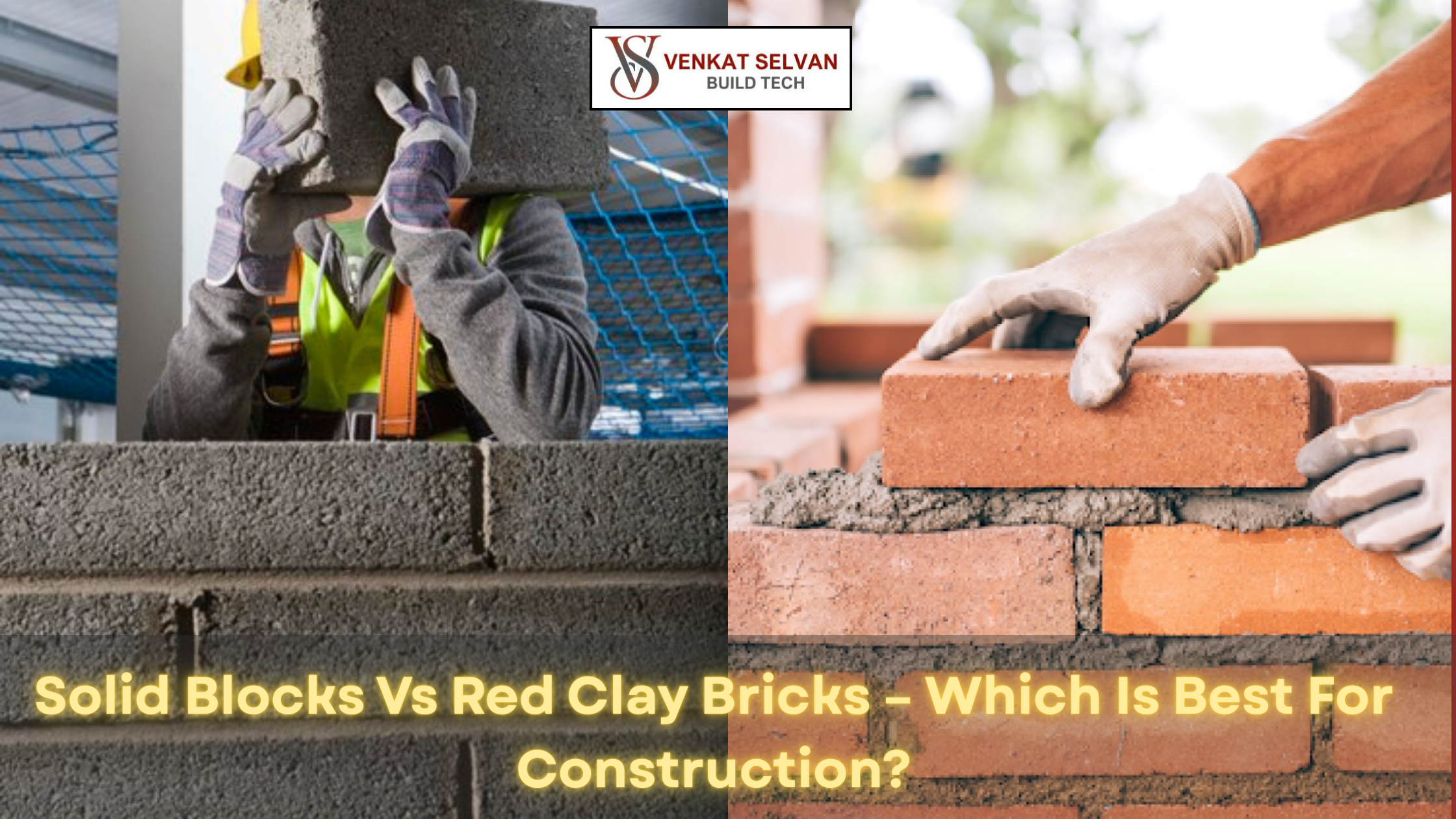
Solid Blocks vs Red Clay Bricks -one of the most debated topics in India, as it shapes your construction dream and ideas. Selecting the right material greatly affects strength, durability, cost, speed of construction, and its maintenance for a long time. This blog will provide you with a comprehensive comparison between these two types of building blocks, red clay bricks, and solid blocks, to help you pick wisely.
Understanding Solid Blocks
The solid blocks are made of concrete masonry units produced through cement, sand, aggregates, and water. They are machine-manufactured under controlled conditions to maintain uniform quality, size, and high compressive strength. These blocks have various applications in residential, commercial, and industrial buildings.
Builders prefer solid blocks for the strengths and reliability that these provide. It is for this reason that the structure is very solid, allowing it to provide excellent load-carrying ability, even in low-rise as well as multi-storey buildings. Solid blocks reduce construction errors due to their homogeneity and ensure stability in structures.
Understanding Red Clay Bricks
The red clay bricks are prepared from natural clay and fired in kilns at very high temperatures. Since Indian construction began, it has been a part of it and is quite common even now, especially in residential projects, more so in rural areas.
While red clay bricks offer a traditional look and good thermal properties, the quality can vary depending on the type of soil, firing method, and different manufacturing practices. It is this inconsistency that could compromise construction quality and durability.
Solid Blocks vs Red Clay Bricks: Strength and Durability
In the comparison of solid blocks vs red clay bricks, the strength of solid blocks stands distinctly ahead. They possess greater compressive strength, making them fit for load-bearing walls and durable structures. Because they bear better resistance to cracks and moisture effects and stand up to the various weather conditions, their performance, with time, is superior.
The red clay bricks are more fragile and may break down while handling. Moisture absorption can weaken the brick, causing cracks and damage to plaster. Where durability and long-term reliability must be ensured, the better option is solid blocks.
Size Uniformity and Construction Speed
Solid blocks are bigger and more regular, which enables them to speed up building, reduce the number of joints, and conserve mortar. As a result, it turns out to be accurately aligned and tidy.
Red clay bricks are of a smaller size, with most having irregular shapes; more mortar is thus needed between the bricks. It also requires skillful labors for proper alignment. This slows down the construction and increases the cost.
Cost Efficiency and Wastage
Although solid blocks may have a slightly higher initial cost, they are actually more cost-effective in the long run. Reduced mortar use, faster construction, lower labor costs, and minimal breakage lower overall expenses.
Red clay bricks are somewhat more prone to wastage due to breakage and come in less than uniform size, which demands higher quantities of mortar and more time in construction, increasing the cost.
Thermal and Sound Insulation
Red clay bricks are good insulators, thermal-wise. These provide a much cooler interior for hot climates, due to which they may be suitable for residential applications.
These solid blocks offer good thermal and sound insulation when used along with insulation and plastering techniques. With their dense structure, they reduce noise transmission and are thus suitable for commercial and industrial buildings.
Environmental Impact
More ecological is the solid block, as it uses less natural soil, reducing environmental degradation resulting from mining clay. Many manufacturers use environmentally friendly ways of production.
Manufacturing red clay bricks consumes fertile topsoil and involves high fuel use, hence contributing to environmental damage and pollution.
Maintenance and Plaster Finish
In turn, this gives solid block walls a much smoother surface; hence, thinner plasters can be used with lesser cracks in time. In the case of red clay brick walls, however, plaster laid needs to be thicker due to the irregularities in the surface. Any cracks also may reflect on the plaster and increase maintenance costs.
Final Verdict: Solid Blocks vs Red Clay Bricks
In the case of solid blocks vs red clay bricks, it all depends upon your project type. When it comes to modern construction requiring strength, durability, speed in execution, cost-effectiveness, and sustainability, solid blocks win hands down. They come with applications for residential, apartments, commercial complex buildings, and industrial projects. The red clay bricks may also be relevant for small-scale or traditional construction but do not hold up in relation to the solid blocks in performance and reliability.
Why Choose Quality Solid Blocks from Venkat Selvan Build Tech?
At Venkat Selvan Build Tech, we manufacture high-quality solid blocks that meet modern construction standards. By using our products, you get superior strengths, accurate dimensions, and a long-lasting life, which guarantee dependable results in every project. When building a home, commercial space, or an industrial unit, picking the right construction material is one of the most critical decisions. With solid blocks by Venkat Selvan Build Tech, you are simply investing in quality, strength, and peace of mind.
Contact Us:
📞 93445 25523
🌐 venkatselvanbuildtech.in
📍 Chennai, India