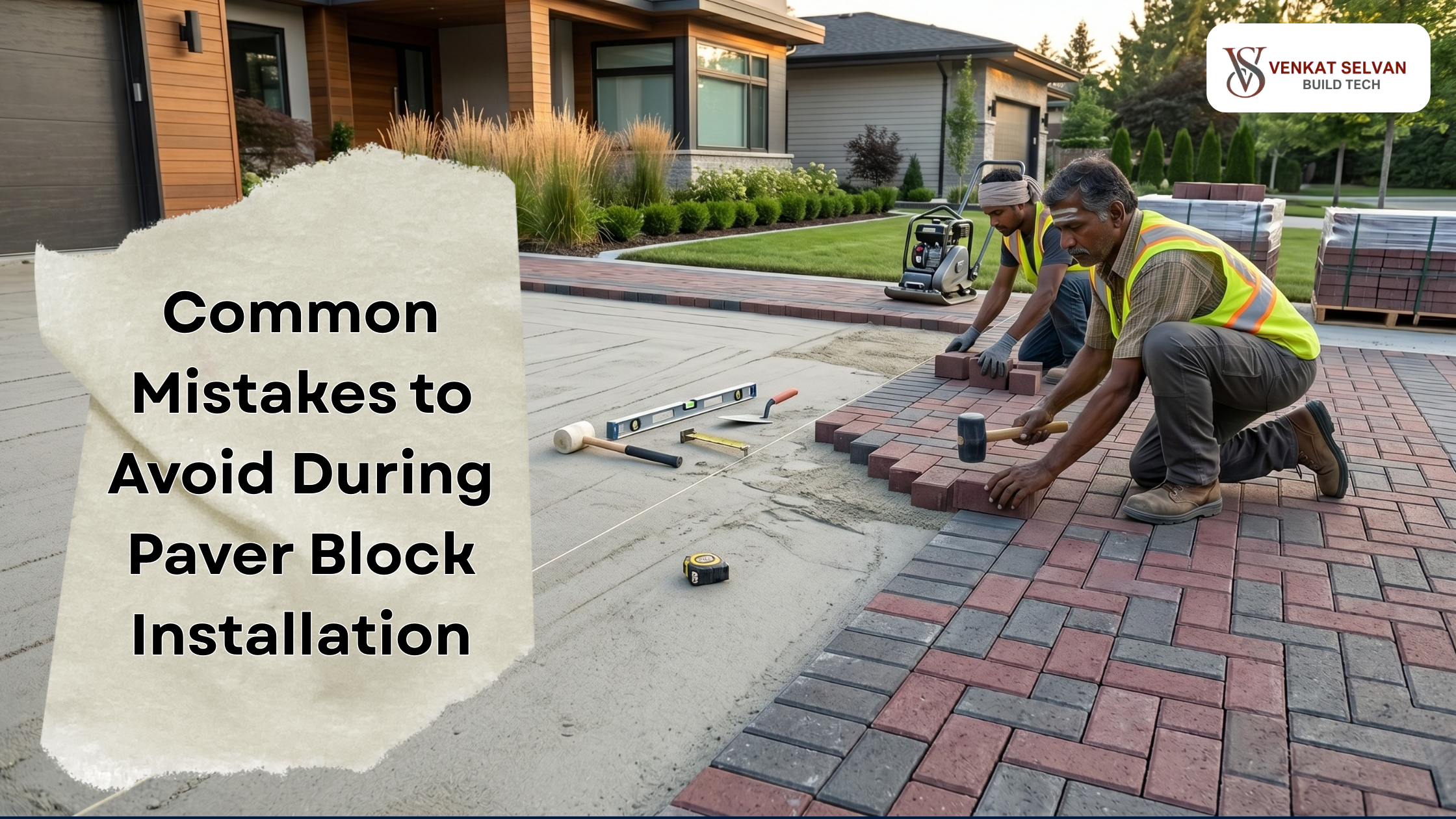
Common Mistakes to Avoid During Paver Block Installation: This is one topic that is of utmost importance to any homeowner, contractor, builder, or property developer that wishes to install long-lasting paving. Paver blocks have become very popular in the construction of driveways, pathways, parking lots, gardens, commercial, and industrial properties owing to their durability, flexibility, and aesthetic appeal. But, no matter how good paver blocks are, improper installation can cause them to break down sooner than expected.
The success of paving depends on its proper installation. Common mistakes when installing paver blocks include uneven surfaces, accumulation of water, unstable blocks, cracks, and expensive repairs.
Why Proper Paver Block Installation Matters
Paver block pavements are designed for load bearing, different weather conditions, and traffic. Nevertheless, all these advantages are provided depending on how correctly the pavement is installed. Proper installation will bring stability, good draining properties, improve aesthetics, and lower maintenance costs.
Conversely, incorrect installation can cause various failures of the pavement, which not only impact its functional capabilities but make the surface look bad as well. That is why it is worth taking some additional time to install the pavement to avoid future complications..
1. Inadequate Site Preparation
One of the most frequent problems of incorrect installation is poor preparation of the installation spot. People often concentrate on the blocks and do not pay enough attention to the condition of the soil under the future pavement.
First, the installation place should be thoroughly cleaned from vegetation, roots, trash, and loose soil. Otherwise, organic elements under the pavement can start to decompose and cause the formation of cavities, which will lead to settling down of the surface.
Such preparation will ensure proper installation of the pavement.
2. Insufficient Excavation Depth
The excavation stage is vital in the installation process. In an attempt to reduce costs and shorten the construction period, some installers undertake excavations that do not meet the minimum requirements.
The depth of the excavations should be proportional to the purpose of the pavement. For instance, pavements that are supposed to support cars need to be deeper compared to those meant for pedestrians. The inadequate depth of excavations leads to sinking of pavement due to lack of proper support.
The correct depth ensures that a good foundation is achieved to support the weight expected.
3. Poor Sub-Base Compaction
Sub-base serves as the structural layer that underlies the pavers. The use of high quality material alone cannot guarantee durability; poor compaction can ruin all the efforts.
The settlement of poorly compacted sub-base material results in depression, dipping, and even movement of pavers. The sub-base layers should always be compacted properly to achieve stability.
The compaction stage ensures proper distribution of weight among others.
4. Using Low-Quality Base Materials
The condition of materials that lie under paver blocks plays a vital role in the performance of the pavement. In some cases, people opt for using inferior aggregates or poor quality material to save money.
Poor-quality materials will cause drainage problems, instability, and failure of the pavement. Quality aggregates offer more load-bearing capacity than inferior aggregates.
Spending money on good quality materials in the first place will help you avoid costly repairs later on.
5. Uneven Bedding Sand Layer
The sand that is used as the bedding layer plays a vital role in creating the surface that will support the paver blocks.
Uneven surfaces will make it harder for the blocks to fit and will also cause unevenness of the finished pavement. Thick bedding layers could also cause the pavement to move.
The sand should be laid out evenly.
Common Mistakes to Avoid During Paver Block Installation: Alignment Errors
Proper alignment is necessary for both aesthetics and structural performance. Some installers ignore guide strings and layout methods, resulting in unevenness in line and spacing.
In addition to compromising on the aesthetics of the pavement installation, misalignment affects the performance of the interlocking pavers since even a small amount of misalignment becomes more prominent when the pavilioned area gets larger.
Using proper layout methods improves the aesthetics of paver block installations while ensuring better structural strength.
6. Ignoring Edge Restraints
The use of edge restraints is crucial to maintaining the integrity of the paver block pavement. The edge restraints act to ensure that the pavers do not spread under loads and thus protect the interlocking patterns.
Without edge restraints, the paver blocks may move around with time, affecting the overall integrity and structure of the paved area. Edge restraints can easily be added to the periphery of the pavement.
7. Improper Joint Filling
Joint sand is crucial for any pavement project involving paver blocks. Joint sand serves to fill spaces between paver blocks to stabilize and interlock them firmly.
An improper installation practice is failure to adequately fill joints or use poor quality joint sand. Inadequate joint sand filling will lower interlock strength resulting in block displacement.
Joint sand should be spread and tamped on the pavement once installation is done.
8. Skipping Final Compaction
In most pavement projects, the most common installation flaw is failure to conduct final compaction properly.
Final compaction ensures that the paver blocks are embedded in the bedding layer. It also aids in the uniform distribution of joint sand all over the pavement.
Final compaction increases pavement strength hence enhancing its durability.
9. Poor Drainage Planning
Among the various elements that can jeopardize the durability of a pavement project, water ranks as one of the most common. Inadequate pavement drainage can lead to erosion and weakening of the pavement structure through water.
Drainage considerations should therefore be made when laying pavement blocks. Proper design should ensure that the pavement has appropriate slope and drainage capacity to divert excess water.
This not only prolongs pavement life but also decreases costs related to pavement maintenance.
10. Choosing the Wrong Paver Blocks
All pavers may not necessarily work in every situation. It is essential to choose pavers according to the intended use rather than based on aesthetic considerations alone.
For instance, paver blocks meant for pedestrian walkways may not be applicable for use on driveways or other areas experiencing heavy traffic. The choice of the appropriate size and thickness of paver blocks ensures durability under the expected loading.
It is advisable to seek the guidance of expert manufacturers or suppliers of paver blocks when selecting appropriate materials.
Tips for a Successful Paver Block Installation
To achieve the best results, consider the following recommendations:
- Prepare the site thoroughly before installation.
- Ensure adequate excavation depth.
- Use high-quality aggregates and bedding materials.
- Compact every layer properly.
- Maintain correct alignment during laying.
- Install strong edge restraints.
- Fill joints completely with suitable sand.
- Perform final compaction carefully.
- Provide effective drainage solutions.
- Choose paver blocks appropriate for the application.
Following these best practices can significantly improve pavement durability and appearance.
Conclusion
Paver blocks provide a durable yet functional pavement system that looks great. To reap maximum benefits from this system, one must adopt proper installation procedures. Installation mistakes like failure to adequately prepare the site, insufficient compaction of soils, inappropriate bedding of pavers, improper joint filling, and lack of adequate drainage can cause many problems down the road.
By avoiding these common mistakes, one can have strong pavements that perform well for many years to come.
Why Choose Venkat Selvan Build Tech for Paver Blocks?
We know at Venkat Selvan Build Tech that apart from the way paving takes place, one must also consider the quality of the paving stones to be laid. At Venkat Selvan Build Tech, we offer paving blocks that are designed to withstand all sorts of weather conditions and traffic loads, along with adding beauty to places where they are used.
From various shapes to sizes, and from designs to colors, Venkat Selvan Build Tech offers paving stones that cater to various needs of builders and contractors. The company is known for offering quality paving stones that have made Venkat Selvan Build Tech a popular choice among contractors.
Need paving stones of premium quality for your next construction job? Contact Venkat Selvan Build Tech today!